
Inside the Knicks Championship Run with Joshua Varughese
The Knicks are champions for the first time in 53 years. Joshua Varughese sits down with SAIS to talk about career, community, and what it felt like to be part of the historic season.

Joshua Varughese didn't grow up with a mapped-out route into sports business. He grew up wanting one.
"I didn't know exactly what that path would look like," he says, "but I was always passionately curious about the industry, the people shaping it, and how the business worked."
Today he's Director of Global Partnerships at Madison Square Garden, working across the Knicks, the Rangers, and MSG's other properties, and if you're looking for a single degree or a single door that got him there, there isn't one. There's a high school kid who decided fandom and career were two different things, and a decade of betting on himself to close the gap.
That distinction, fandom versus career, is where it actually started for him.
"I realized that working in sports meant leaving my fandom at the door and understanding the business behind it," he says of the moment it clicked. "I still loved sports, but I became more interested in how the industry worked, who made the decisions, and how money was made."
That reframe is what turned a passion into a plan, even without a finished blueprint for the plan itself.
The throughline across every job since has been consistency of approach, not consistency of title. Baseball and basketball, agency side and team side, the specifics changed every time. What didn't change: "be passionately curious, learn quickly, build real relationships, and find a way to drive value and impact," he says. "Over time, that becomes your reputation and your personal brand." He's candid that this meant taking jobs before he felt fully ready more than once. "You have to take risks. Sometimes you have to take the opportunity before you feel fully ready, accept that you won't have every answer, and trust yourself to learn along the way."
Nowhere tested that more than Baseball United. As part of the founding group behind the first professional baseball league built for the Middle East and South Asia, based in Dubai, Varughese had a hand in nearly everything: league and franchise branding, the business model, marketing, ticketing, operations, merchandise, partnerships, even the buildout of Baseball United Ballpark itself. "We weren't just launching a new league," he says. "We had to create a product, define the audience, build commercial value, and show fans, investors, and partners why they should believe in it before there was a proven track record." The lesson that stuck: every part of a sports organization is connected, and you make decisions through the lens of the whole business, not just your department.
At MSG, that whole-business instinct is the actual job description. Global partnerships means finding companies that want to use the Knicks, Rangers, and MSG's other properties to grow their own business, and the day-to-day is anything but routine.
"I could be pitching a company in Abu Dhabi in the morning, speaking with a brand in New York or London in the afternoon, and working on a proposal tied to China later that night," he says. "Behind each conversation and partnership is a team helping bring it together, from marketing and strategy to legal and partner management. The strongest partnerships come from everyone's ideas and expertise."

The deal he's proudest of proves that point. Leading the New York Rangers' partnership with Polymarket, the first-ever prediction market deal with a professional sports team, meant building the structure from scratch because no one had done it before. "There was no blueprint. We had to address questions the industry hadn't faced before and build the structure together," he says, crediting a full team effort and a partner willing to stay patient through the unknowns.
None of that is what people picture when they imagine his job, and he knows it. "Being boys with Jalen Brunson and all the players" is a fantasy. The reality is "early calls, late nights, constant meetings, pitches that go nowhere, internal comms, contract details, and bringing a lot of different teams together to get one partnership done. You may see the logo in the arena, but not the months of work it took to put it there."
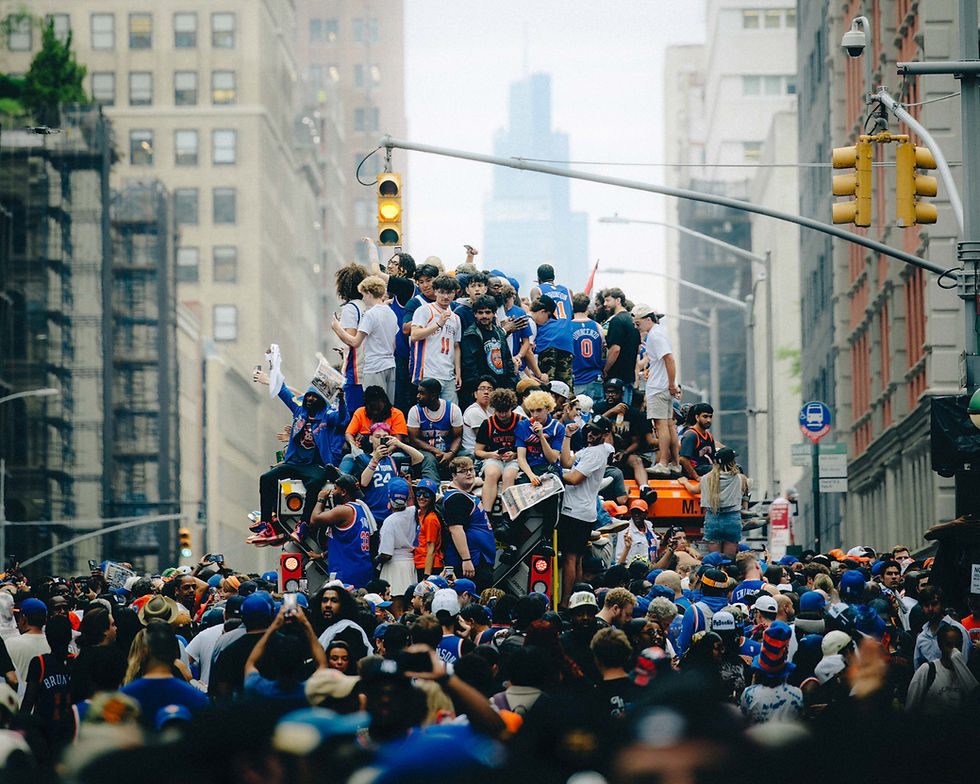
Then the Knicks won it all, and the work paid off in a different currency. Varughese watched Game 5 from his own apartment, surrounded by his team, close friends, and family.
"When the final buzzer went off, everyone lost it," he says. The days after were a blur of celebration and gratitude, quickly followed by a reset. "Winning changed the expectations. The goals are bigger, the standard is higher, and the focus now becomes how we build on that momentum going into next season." His clearest "this is why I do this job" moment came watching fans walk into the Garden during the playoffs and feel it firsthand: "The Knicks weren't just part of the sports conversation. They were the conversation."

His advice for young South Asian professionals trying to break in starts with a reframe of networking itself. "Everyone will say make connections and network, but think about the 100 other people reaching out to that same person asking for an informational meeting or coffee," he says. "Don't only think about what you can take from a conversation. Find a real way to add value and give them a reason to remember you." The second half of his advice is a push to stop waiting for permission: start the podcast, host the dinner series, organize the tournament.
"It doesn't need to be perfect or massive. Take a risk, create something yourself, and show people what you can do."
He points directly at what this community has already built as proof of concept: "Look at what people like Shams, Female Shams, d groups like SAIS, Brown Ballers, and 4thQuarterHQ have built by creating their own lane and putting their work into the world. Just go get it."
He's also pushing back on the idea that a "front office job" is one fixed experience. "Each team and sports organization has its own culture, structure, priorities, resources, and way of working," he says. "A role at a startup league can look completely different from the same title at an established team." His advice is to understand the specific organization you're walking into rather than relying on a general idea of what the job is supposed to be, a lesson Baseball United and MSG taught him from opposite ends of the spectrum.
What's next is scaling what a championship just made possible. Varughese is focused on growing the Knicks' global business and building partnerships in key international markets that feel authentic to the team and to New York, leaning on exactly the kind of ground-floor market-building experience Baseball United gave him. "Coming off the championship, we have an exciting opportunity to introduce the Knicks to new audiences around the world," he says. "I'm looking forward to working alongside our team to build on that momentum and grow the brand internationally."


Comments